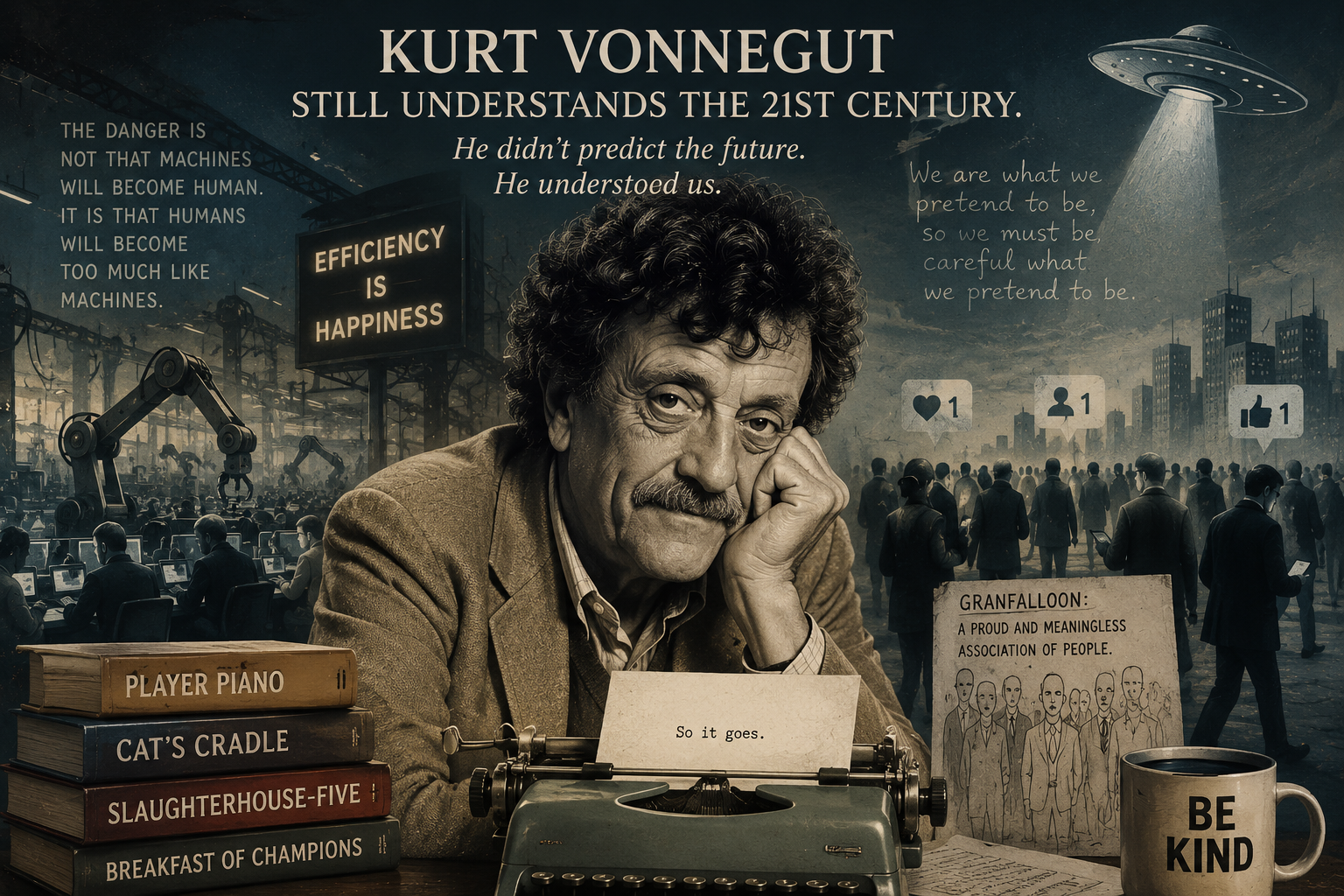
Fig. 1. Why Kurt Vonnegut Still Understands the Twenty-First Century. AI-generated digital illustration created by the author using ChatGPT (OpenAI), 2026
Why Kurt Vonnegut Still Understands the Twenty-First Century: He Didn’t Predict Artificial Intelligence. He Predicted Us.
Every few years, Kurt Vonnegut returns to public conversation with surprising urgency. A new technological breakthrough, another corporate scandal, or the latest debate about artificial intelligence inevitably produces a familiar claim: Vonnegut predicted it.
The statement is understandable. His novels are filled with automated factories, absurd bureaucracies, scientific disasters, and societies that seem to drift toward self-destruction with astonishing confidence. Reading Player Piano in the age of AI or Cat’s Cradle in an era of technological anxiety can feel almost prophetic. But calling Vonnegut a prophet misses the point.
His greatest achievement was never predicting specific technologies. Science fiction has always imagined robots, advanced machines, and future societies. Many writers guessed correctly about inventions that eventually appeared. What separates Vonnegut from those writers is not the accuracy of his predictions but the depth of his observations about the people who would inherit those inventions.
Technology changes. Human psychology rarely does. That is why his novels continue to feel contemporary more than half a century after they were written. Their relevance depends surprisingly little on technological accuracy and almost entirely on their understanding of recurring human behavior.
I remember reading Player Piano for the first time and being struck not by the machines but by the people. The machines felt dated. The engineers, managers, and workers—they felt like people I knew. That was when I realized Vonnegut was not writing about the future. He was writing about us.
The Future Was Never His Subject
Readers often classify Vonnegut as a science fiction writer, partly because his novels include time travel, alien civilizations, futuristic automation, and speculative scientific discoveries. Vonnegut himself resisted that label. Science fiction, as it was often marketed during his lifetime, emphasized imaginative worlds and technological possibilities. His own interests lay elsewhere.
His novels rarely ask, What will technology become? Instead, they ask a more difficult question: What kind of people will we become once technology removes the need to think, choose, or take responsibility? This distinction explains why his books continue to outlive the futures they imagined.
Player Piano (1952), for example, is frequently described as an early warning about automation replacing human labor. That description is accurate—but incomplete. Machines themselves are not the novel’s villains. The tragedy emerges from the social structures built around them. As automation expands, efficiency increases while human purpose quietly disappears. Engineers become priests of a new industrial order, and ordinary people gradually lose not only their jobs but also their sense of usefulness.
The novel is therefore less interested in machinery than in dignity. The question is not whether machines should work. It is what happens to human beings when work no longer gives their lives meaning.
Seventy years later, the question feels strangely familiar. Conversations about artificial intelligence rarely begin with algorithms. They begin with anxiety—about employment, identity, creativity, and value. Vonnegut recognized that technological revolutions are always accompanied by existential ones. He understood that every machine inevitably becomes a mirror. It reflects what we already believe about ourselves.
His Real Subject Was Human Convenience
One misconception about Vonnegut is that he distrusted science. He did not. Throughout his career, he expressed admiration for scientific curiosity while remaining deeply skeptical of the societies that claimed to use science responsibly. His criticism was almost never directed at discovery itself. Instead, it focused on humanity’s remarkable tendency to confuse capability with wisdom. This distinction runs through nearly all of his major novels.
In Cat’s Cradle, the terrifying substance known as Ice-Nine is not created by a mad scientist seeking world domination. It emerges through ordinary scientific research pursued without sufficient reflection on its consequences. The catastrophe that follows is not caused by intelligence but by the absence of ethical imagination.
Knowledge, Vonnegut suggests, is never dangerous on its own. Indifference is. This idea feels especially relevant in the twenty-first century. Public discussions about artificial intelligence often focus on whether machines will become intelligent enough to replace humans. Vonnegut would likely have found that question less interesting than another:
Will humans become passive enough to let machines make decisions they should never surrender?
That concern appears repeatedly throughout his work. His characters often drift through systems so large and complex that personal responsibility begins to dissolve. Bureaucracies replace moral judgment. Institutions replace individual thought. People stop asking whether something is right because they become preoccupied with whether it is efficient.
The danger is not technological progress. The danger is moral laziness. Jerome Klinkowitz, one of Vonnegut’s most perceptive readers, argues that the novelist consistently exposed the gap between technical achievement and ethical maturity, portraying civilizations capable of extraordinary innovation yet incapable of using that innovation wisely (Klinkowitz 42–45). This is perhaps the central paradox of Vonnegut’s fiction. His novels are populated by brilliant scientists, engineers, generals, executives, and inventors. Intelligence is everywhere. Wisdom is astonishingly rare. That imbalance—not technological advancement itself—is what makes his work feel permanently contemporary.
The Most Dangerous Machine Is the Human Mind
If there is a villain in Vonnegut’s fiction, it is almost never a machine. It is the human desire to surrender responsibility. This is where many contemporary readings of Vonnegut fall short. They interpret his novels as warnings about technological progress, when they are more accurately read as warnings about intellectual complacency. His characters are rarely defeated by inventions; they are defeated by their willingness to stop thinking once a system begins thinking for them. This theme appears repeatedly across his work.
In Player Piano, automation does not simply replace workers. It replaces judgment. Decisions once made by individuals become embedded in systems that appear objective because they are efficient. Engineers no longer ask whether society should be organized this way; they merely optimize it. The machine becomes morally neutral only because the humans operating it refuse to examine the values encoded within it.
The same pattern emerges in Cat’s Cradle. Ice-Nine is often interpreted as a metaphor for nuclear weapons, yet its symbolic power extends beyond the Cold War. The substance represents knowledge detached from responsibility. Felix Hoenikker, the brilliant scientist who invents it, never appears malicious. He is simply uninterested in consequences. His curiosity exists in isolation from ethics.
Vonnegut’s point is devastatingly simple. Intelligence without moral imagination becomes dangerous not because it intends evil but because it no longer asks why.
Hannah Arendt described something similar while analyzing the bureaucratic structures of the twentieth century. Evil, she argued, often emerges not from monstrous intentions but from ordinary people who cease to think critically about the systems they serve (Arendt, Eichmann 287–92). Although Vonnegut approached the problem through satire rather than political philosophy, his fiction arrives at a remarkably similar conclusion: Bureaucracy becomes dangerous when it replaces conscience with procedure.
This explains why institutions occupy such a central place in his novels. Corporations. Military organizations. Governments. Scientific laboratories. Universities. These are not inherently oppressive spaces. Instead, they become environments in which individuals gradually outsource moral responsibility. Characters begin to speak the language of efficiency, necessity, or professional obligation instead of personal judgment. The institution thinks on their behalf, allowing them to believe they bear little responsibility for its outcomes.
More than fifty years later, this insight feels uncannily relevant. Artificial intelligence has intensified public anxiety about machines making decisions once reserved for humans. Yet algorithms themselves possess neither ambition nor morality. They optimize according to the objectives they are given. The ethical question therefore lies elsewhere: Who defines those objectives? Who accepts responsibility when optimization conflicts with human values?
Vonnegut would almost certainly have insisted that these are human questions rather than technological ones. The danger is not that machines will become too human. It is that humans will grow more machine-like.
Why We Keep Rediscovering Vonnegut
There is a curious pattern in Kurt Vonnegut’s reputation. He never quite disappears. Instead, every few years—usually during periods of political uncertainty, technological upheaval, or cultural anxiety—readers return to his novels as though they contain answers to questions that have only just emerged. Articles proclaim that Vonnegut “predicted AI,” “predicted social media,” or “predicted corporate America.” His books trend briefly, quotations circulate online, and his reputation as a literary prophet grows stronger.
Yet this cycle of rediscovery tells us less about Vonnegut than it does about ourselves. We return to him because we continue to confront the same ethical dilemmas in new forms. The technology changes. The vocabulary changes. The psychology remains strikingly consistent.
This explains why Player Piano, despite being published in 1952, often feels more relevant than novels written decades later. The factory machines it describes now appear technologically primitive, but the questions it raises have only become more pressing. What makes a person valuable? Can efficiency replace purpose? What happens when economic systems measure productivity more accurately than they measure dignity?
These are no longer questions about industrial automation alone. They have become central concerns in debates surrounding artificial intelligence, digital labor, and algorithmic management.
Vonnegut never needed to imagine today’s technologies because he understood the emotional patterns that would accompany them. He recognized that every generation believes its technological revolution is unprecedented. Steam engines, electricity, nuclear power, computers, the internet, and artificial intelligence have each been presented as moments that fundamentally redefine humanity. Yet beneath these transformations lies a far older tendency: our desire to believe that technical progress automatically produces moral progress. Vonnegut repeatedly challenges this assumption. Scientific advancement, he suggests, expands human capability. It does not automatically expand human wisdom.
This balance distinguishes him from many dystopian writers. George Orwell feared authoritarian surveillance. Aldous Huxley feared passive entertainment. Ray Bradbury feared cultural censorship. Vonnegut feared something quieter. He feared that ordinary people would gradually surrender their capacity for independent judgment while believing themselves to be perfectly free.
Charles J. Shields, Vonnegut’s biographer, notes that the novelist’s personal experiences—including witnessing the destruction of Dresden—shaped his understanding of how ordinary people participate in extraordinary cruelty (Shields 115–18). Vonnegut never forgot that the capacity for evil is distributed across populations, not concentrated in villains. This is why his satire is never directed at evil individuals. It is directed at the systems that make evil ordinary.
Conclusion
The enduring relevance of Kurt Vonnegut has very little to do with his ability to anticipate the future. His real achievement was recognizing that while technologies evolve at extraordinary speed, the habits of human thought evolve much more slowly. We continue to seek comfort in systems, confuse efficiency with meaning, and imagine that technical solutions can resolve fundamentally ethical problems.
Artificial intelligence did not prove Vonnegut right. Human nature did. That is why his novels remain essential reading in the twenty-first century. They ask readers to look beyond machines and examine the people who build them, govern them, and increasingly depend upon them. In doing so, they shift the conversation away from technological anxiety and toward moral responsibility.
Perhaps this is Vonnegut’s most important lesson. The future will never be determined solely by the intelligence of our machines. It will always depend on the courage, humility, and judgment of the people who choose how those machines are used.
Further Reading
Arendt, Hannah. Eichmann in Jerusalem: A Report on the Banality of Evil. Penguin Books, 2006. (A foundational study of how ordinary bureaucracy can normalize moral irresponsibility, offering a philosophical framework that closely parallels Vonnegut’s concerns.)
Klinkowitz, Jerome. The Vonnegut Effect. University of South Carolina Press, 2004. (One of the most influential critical studies of Vonnegut’s fiction, examining the ethical and cultural ideas that run throughout his work.)
Shields, Charles J. And So It Goes: Kurt Vonnegut: A Life. Henry Holt and Company, 2011. (A comprehensive biography that connects Vonnegut’s personal experiences with the moral and political themes of his novels.)
Vonnegut, Kurt. Cat’s Cradle. Holt, Rinehart and Winston, 1963. (Explores the relationship between scientific knowledge, ethical responsibility, and the unintended consequences of technological progress.)
Vonnegut, Kurt. Player Piano. Charles Scribner’s Sons, 1952. (Examines automation, work, and human purpose, making it especially relevant to contemporary discussions of artificial intelligence.)