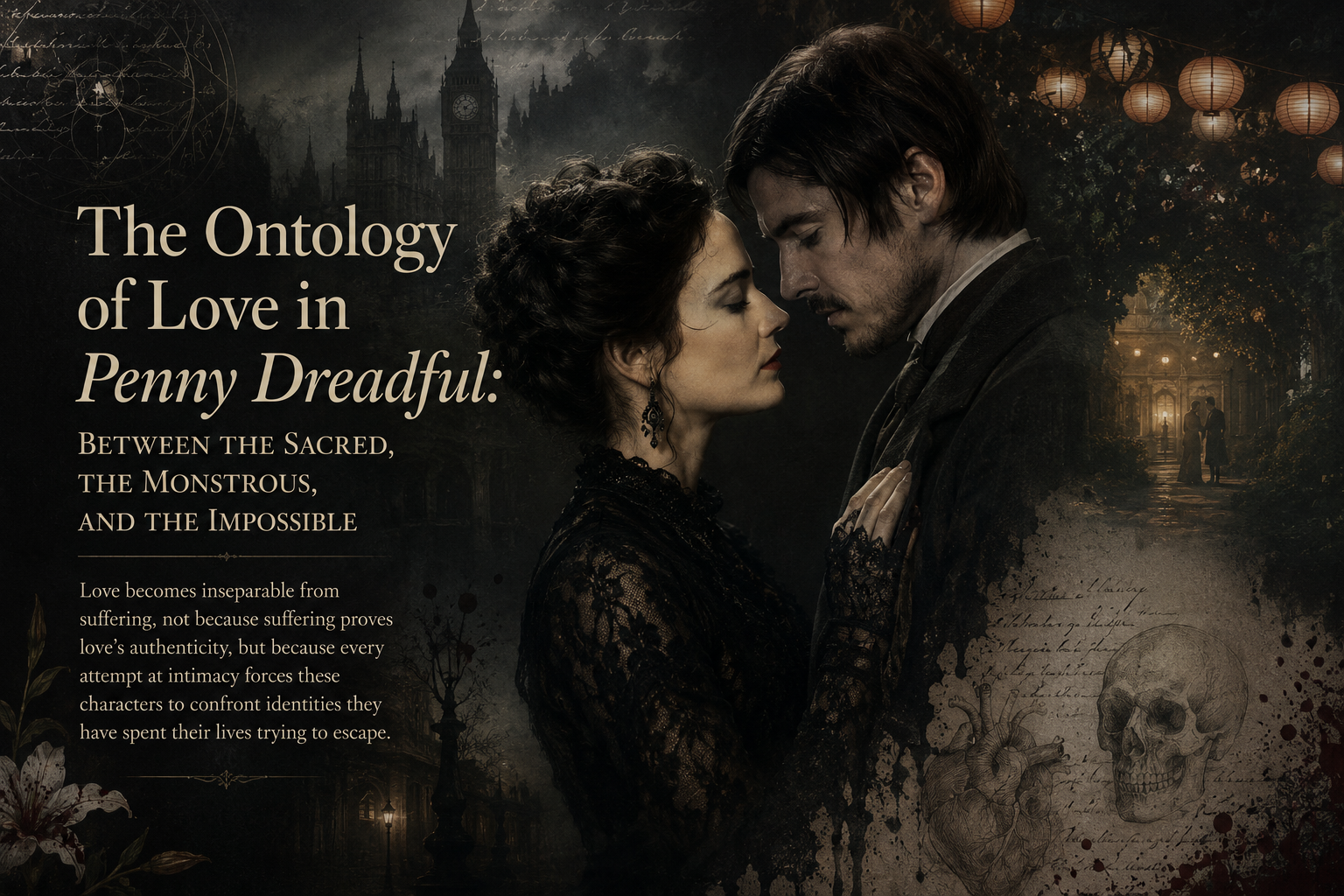
Fig. 1. Cover illustration for The Ontology of Love in Penny Dreadful: Between the Sacred, the Monstrous, and the Impossible. AI-assisted digital artwork created by the author. 2026.
The Ontology of Love in Penny Dreadful: Between the Sacred, the Monstrous, and the Impossible
There is a moment in Penny Dreadful that has never truly left me. It is not one of the exorcisms, nor the blood-soaked confrontations with witches and demons. It is quieter than that. Vanessa Ives and Ethan Chandler dance together beneath strings of lanterns in a garden, the world briefly dissolving around them. Abel Korzeniowski’s score does not simply accompany the scene, it breathes with it, as if every note knows that this happiness has already become a memory before it has even begun. The camera lingers on stolen smiles and hesitant glances, allowing silence to speak louder than dialogue ever could. For a few fleeting minutes, they are not haunted people. They are simply a woman and a man discovering what peace might feel like.
And yet, the beauty of that scene comes from a devastating certainty: it cannot last.
Most television romances build themselves around a simple promise. Love will overcome. If the lovers endure enough suffering, happiness will eventually reward them. Penny Dreadful rejects that promise from its very first episode. It understands love not as a solution but as a wound, a force capable of revealing who we truly are, while simultaneously exposing everything that prevents us from becoming whole. That is why none of its relationships are allowed a conventional ending. The tragedy is not that evil keeps separating the lovers. The tragedy is that each character carries a version of exile within themselves long before supernatural darkness ever arrives.
Watching the series for the first time, I thought Vanessa and Ethan were simply victims of unfortunate circumstances. Watching it again years later, I realized something far more unsettling. They are not prevented from loving each other because demons interfere with their lives. They fail because both of them have already accepted the belief that they are fundamentally beyond redemption. The monsters surrounding them merely give visible form to convictions they already hold inside themselves.
Perhaps that is why their story feels painfully real despite its Gothic setting.
The older I become, the less interested I am in stories where love saves people. Reality rarely works that way. Sometimes love arrives only to illuminate the deepest fractures within us. It reveals the parts we desperately hoped no one would ever see. It asks for vulnerability precisely from those who have built their identities around survival. In that sense, Penny Dreadful has always felt strangely honest. Its monsters are extraordinary, but the emotional architecture beneath them is painfully familiar.
This is where philosophy becomes unexpectedly useful—not because it offers neat explanations, but because it provides a language for experiences that ordinary conversation often fails to capture. Plato imagined love as the soul’s longing for completeness, an ascent toward something eternal. Christian theology distinguished between eros, the passionate desire that reaches outward, and agape, the selfless love that sacrifices itself without demanding possession. Freud complicated both ideas by insisting that every impulse toward life is shadowed by an equally powerful movement toward destruction. Eros and Thanatos are not opposites that alternate politely; they exist together, intertwined, each quietly shaping the other.
No television series I have seen embodies that paradox more completely than Penny Dreadful. Every relationship in the narrative seems suspended between the longing to be known and the certainty of inevitable ruin. Love becomes inseparable from suffering, not because suffering proves love’s authenticity, but because every attempt at intimacy forces these characters to confront identities they have spent their lives trying to escape.
Vanessa Ives embodies this contradiction more completely than anyone else. She is often described as the moral center of the series, yet that description has always seemed incomplete to me. Vanessa is not simply torn between God and the Devil, purity and corruption, salvation and temptation. Those binaries are too comfortable. Her deepest conflict is far more terrifying: she cannot imagine an identity that exists outside the struggle itself.
Vanessa’s faith has never struck me as peaceful. It is restless, desperate, almost violent in the way it clings to transcendence while being irresistibly pulled toward darkness. She prays with the intensity of someone who does not merely seek God but begs to remain herself. That distinction matters. In Penny Dreadful, religion is never presented as a stable refuge. Instead, it becomes another battlefield where identity is negotiated through pain.
The possession scenes make this painfully clear. On the surface, they resemble familiar Gothic horror: ancient languages, twisted bodies, impossible voices. Yet what unsettles me most is not the supernatural spectacle. It is Eva Green’s gaze. Even before a demon speaks through Vanessa, her eyes often suggest someone listening to a conversation no one else can hear. There is always a hesitation before she answers, as though every sentence must first survive an invisible trial. The horror is not simply that evil enters her. It is the unbearable uncertainty that she might no longer distinguish between what is being whispered to her and what already belongs to her own soul.
That uncertainty transforms love into something almost sacred. Ethan is not important because he promises rescue. He matters because, for brief moments, Vanessa allows herself to imagine a self that is not entirely defined by guilt. When they sit together in silence or exchange those almost embarrassed smiles that neither of them quite knows how to hold, the series accomplishes something remarkably difficult. It makes ordinary tenderness feel more miraculous than any exorcism.
The ballroom sequence remains one of the clearest examples. Nothing extraordinary happens. There are no monsters, no prophecies, no blood. Yet it feels almost supernatural because normality has become the most unattainable fantasy in their lives. Korzeniowski’s score swells with restrained melancholy rather than triumph, refusing to let the audience forget that this fragile happiness exists outside of time. Even while watching it for the first time, I found myself mourning something that had not yet been lost.
That feeling reminds me less of romantic cinema than of Kierkegaard’s understanding of despair. Despair, for him, is not simply sadness but the inability to become oneself. Looking back, I realize Vanessa never truly believes she deserves the ordinary life she briefly imagines with Ethan. She desires it with every part of her being, yet she experiences that desire almost as a temptation. Happiness appears suspicious because suffering has become the only identity she fully recognizes.
Ethan mirrors this tragedy in a different register. His curse is visible where Vanessa’s remains largely spiritual, but psychologically they are astonishingly similar. Both have internalized the belief that love inevitably harms the person standing closest to them. Ethan repeatedly distances himself from intimacy not because he lacks feeling, but because affection immediately awakens responsibility, and responsibility reminds him of destruction. The wolf is terrifying, yet what ultimately isolates him is not his transformation beneath the full moon. It is the conviction that everyone he touches will eventually pay for loving him.
This is why I have never been satisfied by interpretations that reduce their relationship to external obstacles. Witches, demons, prophecies—these certainly shape the narrative, but they are not its deepest conflict. If every supernatural force disappeared overnight, I am not convinced Vanessa and Ethan would suddenly find peace. Their greatest enemy has always lived within them: the quiet certainty that they are fundamentally unworthy of receiving the very love they so desperately long for.
At that point, love ceases to be a destination. It becomes an ontological impossibility.
The tragedy extends far beyond Vanessa and Ethan. Victor Frankenstein believes that creation entitles him to love, yet every act of affection he offers is poisoned by possession. He calls himself a father, but what he truly desires is gratitude. The Creature, abandoned the moment he opens his eyes, spends the entire series searching not for revenge but for recognition. His greatest suffering is not physical rejection; it is existing in a world where no one is willing to meet his gaze without first seeing a monster. Lily understands this before anyone else. She refuses the role of the obedient creation because love that demands submission is simply another form of domination. In that sense, her rebellion is not the rejection of love itself but the rejection of being loved only under someone else’s conditions.
Even Dorian Gray, the man who appears to possess unlimited freedom, quietly reinforces the same idea. He experiences endless desire but never genuine intimacy. Every encounter remains suspended on the surface because immortality has stripped desire of its most essential companion: finitude. Without the possibility of loss, love becomes little more than aesthetic consumption. Dorian collects experiences the way others collect paintings, yet nothing transforms him. His eternity is not a privilege but an emotional prison.
Perhaps this is why Penny Dreadful continues to haunt me long after I have forgotten the details of other television dramas. It refuses to comfort its audience with the reassuring fiction that love heals every wound. Instead, it asks a far more unsettling question: what if love does not fail because we cannot find the right person, but because we cannot believe ourselves capable of being loved? That question lingers beneath every silence, every hesitant touch, every farewell the series offers.
The final image of Vanessa’s story has often been described as heartbreaking. I experienced it differently. It felt inevitable—not because fate demanded it, but because the series had been preparing us from the very beginning to understand that some souls seek grace while remaining convinced they have already fallen beyond its reach. That paradox is the true Gothic heart of Penny Dreadful. Its monsters are unforgettable, but they are never the point. The real horror is discovering that the most impossible distance is not between heaven and hell, nor between humanity and monstrosity. It is the distance between a person and the simple, terrifying possibility that they might deserve to be loved.
Further Reading
Plato. Symposium. (The foundational philosophical text on love as the soul’s longing for beauty, wholeness, and transcendence.)
Søren Kierkegaard. The Sickness Unto Death. (Essential for understanding despair, selfhood, and why Vanessa’s deepest struggle is existential rather than merely moral.)
Sigmund Freud. Beyond the Pleasure Principle. (Introduces the dynamic between Eros and Thanatos that underlies the series’ intertwining of love and destruction.)
Anders Nygren. Agape and Eros. (Explores the distinction between selfless and possessive forms of love, a tension central to the relationships in Penny Dreadful.)
Julia Kristeva. Powers of Horror: An Essay on Abjection. (A seminal work on abjection and the blurred boundaries between self and other, purity and corruption.)
Noël Carroll. The Philosophy of Horror, or Paradoxes of the Heart. (Examines why horror attracts us emotionally and intellectually, offering valuable insight into Gothic storytelling.)
David Punter. The Literature of Terror: A History of Gothic Fictions from 1765 to the Present Day. (Provides a comprehensive history of the Gothic tradition that shaped Penny Dreadful.)
Fred Botting. Gothic. (A concise introduction to Gothic literature, its recurring motifs, and its cultural significance.)
Jeffrey Jerome Cohen (ed.). Monster Theory: Reading Culture. (Argues that monsters embody cultural anxieties, making it indispensable for interpreting the series’ creatures symbolically.)
Barbara Creed. The Monstrous-Feminine: Film, Feminism, Psychoanalysis. (Explores how femininity, horror, and psychoanalysis intersect, offering an illuminating lens for Vanessa and Lily.)
Slavoj Žižek. The Fragile Absolute: Or, Why Is the Christian Legacy Worth Fighting For? (Investigates Christianity, sacrifice, and redemption through a contemporary philosophical perspective.)
Simon Critchley. The Book of Dead Philosophers. (An engaging introduction to major philosophical ideas about life, death, and meaning that complements the themes explored in this essay.)